1st FALAN Latin American Training Program in Neuroscience
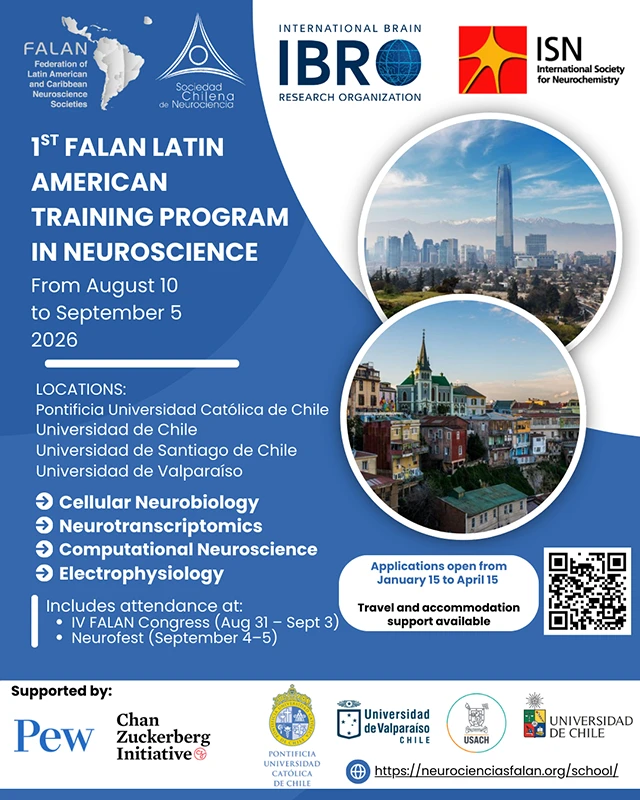
From August 10 to September 5, 2026
School format: In person
Locations:
Pontífica Universidad Católica de Chile
Universidad de Chile
Universidad de Santiago de Chile
Universidad de Valparaíso
Cellular Neurobiology
Neurotranscriptomics
Computational Neuroscience
Electrophysiology
Includes attendance at:
– IV FALAN Congress (Aug 31 – Sept 3)
– Neurofest (September 4-5)
Organizing committee
– Dr. Julio Alcayaga, Universidad de Chile, Chile
– Dr. Víctor Hugo Cornejo, Pontificia Universidad Católica de Chile, Chile
– Dr. Ricardo Delgado, Universidad de Chile, Chile
– Dr. Jaime Eugenín, Universidad de Santiago de Chile, Chile
– Dr. Marco Fuenzalida, Universidad de Valparaíso, Chile
– Dr. Sergio Hidalgo, Washington State University, USA
– Dr. Sebastián Loyola, Universidad Católica Silva Henríquez, Chile
– Dr. Patricio Olguín, Universidad de Chile, Chile
– Dr. Patricio Orio, Universidad de Valparaíso, Chile
– Dr. Angelina Palacios, Universidad de Valparaíso, Chile
– Dr. María Pertusa (Coordinator), Universidad de Santiago de Chile, Chile
– Dr. Patricio Rojas, Universidad de Santiago de Chile, Chile
– Dr. Jimena Sierralta, Universidad de Chile, Chile
Aim and scope of the school
The FALAN Latin American Training Program in Neuroscience is a regional initiative designed to enhance neuroscience education by providing high-quality, continuous training for graduate students across Latin America.
About the school
This intensive program will provide a thorough overview of how the nervous system is studied. The School is primarily designed to provide both theoretical and practical training to postgraduate students (Master’s and PhD) pursuing advanced studies in neuroscience, covering topics such as electrophysiology, computational neuroscience, intravital microscopy, and neurotranscriptomics. In addition to the scientific curriculum, the program will feature sessions on writing successful research proposals, crafting compelling personal statements, and creating strong academic CVs.
The final week will focus on student participation in the IV FALAN Congress and Neurofest, where we expect that the knowledge and skills they have gained throughout the first three weeks of this School, will enhance their experience at the FALAN Meeting (August 31-September 3). The last event the students will participate in is Neurofest, a public event organized by the Chilean neuroscience community to engage the public with neuroscience. This event is scheduled for September 4 and 5.
Who can apply to this school?
Master’s and PhD students from any Latin American country are eligible to apply. Applicants must be currently enrolled in a graduate program at the master’s or doctoral level at the time of application.
Selected students will receive financial support to cover travel and accommodation expenses for the duration of the activity.
Selection criteria
1. Academic merit will be assessed based on years of professional experience, including considerations for maternity leave, sick leave, or leave taken to care for dependents.
2. One of the activities of this school is attending the IV FALAN Congress. Applicants must be the first author on the posters they present at the congress.
3. Submissions from all areas of neuroscience will be eligible for consideration.
4. Scholarships will be awarded based on criteria such as gender equity and equitable distribution among different regions.
5. Only one student per laboratory will receive funding.
Applications start date 15/01/2026
Applications end date 15/04/2026
| Monday August 10 | Tuesday August 11 | Wednesday August 12 | Thursday August 13 | Friday August 14 | |
| 9:00- 10:00 | Opening Session IBRO/ISN Presentation Host Organizing Committee members | Ion channels and membrane excitability Dr. Patricio Rojas (Universidad de Santiago de Chile) | Optogenetic investigation of neural circuits in vivo Dr. Elias Leiva (Universidad de Santiago de Chile) | EEG for Neuroscience Research(I) Dr. Boris Lucero (Universidad Católica del Maule) | Students’ presentations |
| 10:00-11:00 | Title to be confirmed Dr. Ramón Latorre (CINV) | The patch- clamp technique Dr. Fernando Ortiz (Universidad de Santiago de Chile) | In vivo electrophysiological recordings Speaker to be confirmed | EEG for Neuroscience Research (II) Dr. Christ Devia (Universidad de Chile) | Students’ presentations |
| 11:00-11:30 | Coffee Break | Coffee Break | Coffee Break | Coffee Break | Coffee Break |
| 11:30-12:30 | Speaker to be confirmed | Ion channels in thermotransduction Dr. Rodolfo Madrid (Universidad de Santiago de Chile) | Speaker to be confirmed | Active perception in the visual system, Dr. Pedro Maldonado (Universidad de Chile) | Students’ presentations |
| 12:30-14:00 | Lunch Break | Lunch Break | Lunch Break | Lunch Break | Lunch Break |
| 14:00-18:00 | Hands-onWorkshop | Hands-onWorkshop | Hands-onWorkshop | Hands-onWorkshop | Professional Development Workshop. |
| Monday August 17 | Tuesday August 18 | Wednesday August 19 | Thursday August 20 | Friday August 21 | |
| 9:00- 10:00 | Principles of Neural Modeling: from Neurons to Networks I Dr. Patricio Orio (Universidad de Valparaíso) | Whole-brain modeling and applications I Dr. Wael El-Deredy (Universidad de Valparaíso) | Structural Brain Connectivity Analysis Dr. Pamela Guevara (Universidad de Valparaíso) | Neurobiology of Psychiatric Disorders Speaker to be confirmed (Universidad de Valparaíso) | Neuroinflammation in Health and Disease Speaker to be confirmed (Universidad de Valparaíso) |
| 10:00- 11:00 | Principles of Neural Modeling: from Neurons to Networks II Dr. Patricio Orio (Universidad de Valparaíso) | Whole-brain modeling and applications II Dr. Mónica Otero (Universidad San Sebastián) | Methods of Information Dr. Leonel Medina (Universidad de Santiago de Chile) | Neurobiology of Psychiatric Disorders Speaker to be confirmed (Universidad de Valparaíso) | Neuroinflammation in Health and Disease Speaker to be confirmed (Universidad de Valparaíso) |
| 11:00- 11:30 | Coffee Break | Coffee Break | Coffee Break | Coffee Break | Coffee Break |
| 11:30- 12:30 | Exploring Basal Ganglia Function Through Computational Modeling Dr. Javier Baladron (Universidad de Santiago de Chile) | Whole Brain modelling and Brain oscillations Dr. Felipe Torres (Universidad Católica del Maule) | Entropy and complexity analyses of electrophysiological signals: Application to Alzheimer’s disease detection in the eye”. Dr. Leonel Medina. (Universidad de Santiago de Chile) | Neurobiology of Psychiatric Disorders Speaker to be confirmed (Universidad de Valparaíso) | Neuroinflammation in Health and Disease Speaker to be confirmed (Universidad de Valparaíso) |
| 14:00- 18:00 | Hands-onWorkshop | Hands-onWorkshop | Hands-onWorkshop | Hands-onWorkshop | Students’ presentations |
| Monday August 24 | Tuesday August 25 | Wednesday August 26 | Thursday August 27 | Friday August 28 | |
| 9:00-10:00 | Molecular Mechanism of synaptic dysfunction in neurodegeneration Dr. Alejandra Álvarez. (Pontificia Universidad Católica de Chile) | Molecular and cellular mechanisms mediating sensory transmission Dr. Evelyn Avilés Dr. Margarita Calvo (Pontificia Universidad Católica de Chile) | Bulk short-read and long-read sequencing for isoform discovery Dr. Christine H. Tabuloc (University of California, Davis) | To be confirmed. Multi-omics approaches in biomedicine Dr. Lucia Peixoto (Washington State University) | Adaptive optics for in vivobrain Dr. Cristina Rodríguez (Yale University) |
| 10:00-11:00 | Intracellular trafficking of membrane proteins in neurons Dr. María Paz Marzolo (Pontificia Universidad Católica de Chile) | Molecular bases of the nervous system development Dr. Ignacio Cancino Dr. Francisca Cornejo (Pontificia Universidad Católica de Chile) | Single-cell sequencing Dr. Vinicius Maracaja-Coutinho (Universidad de Chile) | Spatial transcriptomics in neuroscience Dr. Xiangmin Xu (University of California, Irvine) | Optogenetic manipulation of visual perception Dr. Luis Carrillo (Universidad Nacional Autónoma de México) |
| 11:00-11:30 | Coffee Break | Coffee Break | Coffee Break | Coffee Break | Coffee Break |
| 11:30-12:30 | Intravital microscopy techniques for monitoring brain activity and metabolism Dr. Víctor Hugo Cornejo Dr. Andrés González (Pontificia Universidad Católica de Chile) | Molecular and neurochemical bases of compulsive behaviours Dr. María Estela Andrés (Pontificia Universidad Católica de Chile) | Transcriptional profiling of cell lineages of sex-differentiated neurons Dr. E. Josie Clowney (University of Michigan) | Integration of spatial and single-cell transcriptomics datasets Dr. Sergio Hidalgo (Washington State University) | Title to be confirmed Dr. Xiangmin Xu (University of California, Irvine) |
| 14:00-18:00 | Hands-onWorkshop | Hands-onWorkshop | Hands-onWorkshop | Hands-onWorkshop | Professional Development Workshop. |
Hands-on Workshops 1st week
- Synaptic Plasticity in the Hippocampus
- In vitro Ca2+ -Imaging
- Measurement of the C Reflex
- Physics of Electrical Neurostimulation
- How to Set Up a “Dirt-Cheap” Electrophysiology Rig
- EEG Analysis During Continuous Speech Perception Using Multivariate Temporal Response Functions (mTRF)
- Two-electrode voltage-clamp of the neuromuscular Drosophila synapse
Hands-on Workshops 2nd week:
- Computational Neuroscience Practical
- Genes and behavior
- Expression and function of ion channels
- Western Blot, Histology, and Structural Synaptic Plasticity by Fluorescence Microscopy
- Nervous tissue slicing techniques and patch-clamp recordings in slices
- Neuromodulation in central synapses using electrophysiological recordings
- Analysis of neural circuits using a multi-electrode array (MEA)
- Use of genetically encoded reporter lines to visualize cells in the developing nervous system
- Chemogenetics
- Methods for studying intercellular communication
- Techniques for measuring brain neurotransmitters
- Recording neural activity in vivo from freely behaving mice: technical and analytical approaches
Hands-on Workshops 3rd week:
- In vivo Microdialysis in Rat or Mouse Models, Including Stereotaxic Surgery and Live Rat Demonstration
- Preparation of Hippocampal Neuron Cultures and Analysis of Dendritogenesis
- Studying Central Nervous System Development Using Brain Organoids
- Learning About the Nervous System and Locomotor Behavior in Invertebrate Models (C. elegans and Drosophila)
- In vivo Imaging of Neuronal Activity in the Mouse Somatosensory Cortex Using Multiphoton Microscopy
- Low-Cost Laser Illumination for Microscopy (2 days), Dr. Vicente Parot, Pontificia Universidad Católica de Chile.